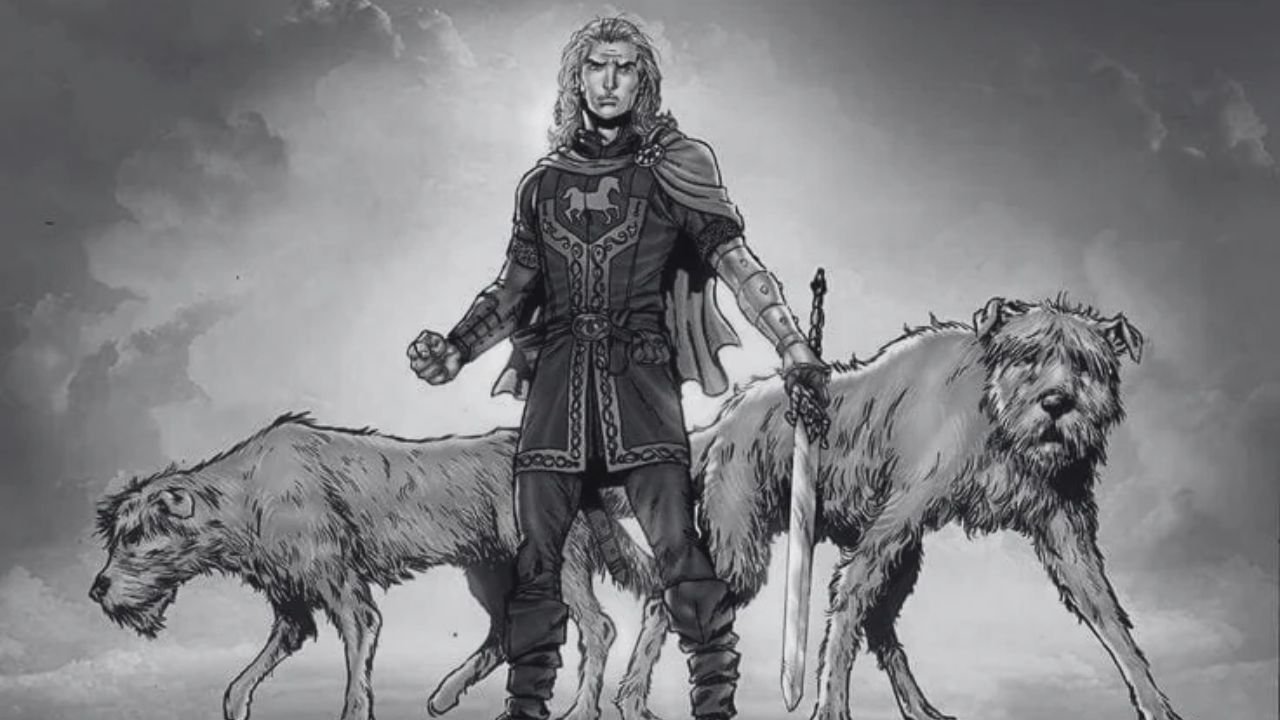
The name Fionn Mac Cumhaill turns up in Irish mythology, genealogy websites, tourist landmarks, and children’s books. Yet many people are genuinely unsure what to make of it. Was he a real person? A fictional character? Something in between?
This article covers who Fionn Mac Cumhaill actually is, what his name means, his family as described in Irish tradition, the stories most connected to him, and how to think clearly about his name when it appears in genealogy searches.
The Name Fionn Mac Cumhaill and What It Actually Means
The name itself tells you something right away. “Mac Cumhaill” means “son of Cumhall,” which makes it a patronymic — a name based on the father’s name — rather than a conventional inherited surname in the modern sense.
In Old Irish, the name Fionn is associated with brightness or fairness. It is a descriptive name, not an unusual one in early Irish culture.
If you have seen the names Finn McCool or Finn MacCool, those are anglicized versions of the same figure. They are not different people. The spelling shifts depending on the source, the era, and whether you are reading an Irish, English, or Scottish account. All of them point back to Fionn Mac Cumhaill.
Fionn’s Place in Irish Mythology
Fionn is not a king, a saint, or a documented historical ruler. He is the central hero of the Fenian Cycle, also known as the Ossianic tradition. This is one of four main cycles of early Irish literature.
The Fenian Cycle is separate from the Ulster Cycle, which features Cú Chulainn. They belong to different story-worlds with different casts of characters, different settings, and different themes. Mixing them up is a common mistake.
Within his cycle, Fionn is portrayed as a warrior, hunter, poet, and seer. He is not framed as a king sitting on a throne. He leads a roving band, lives close to the land, and is associated with wisdom as much as physical strength.
Some traditional stories place him in the era of the High King Cormac mac Airt, loosely described in those accounts as the second or third century. This is a legendary story-world setting, not a verified date from historical records. It is worth being clear on that distinction.
His Family — Cumhall, Muirne, Oisín, and Oscar
Traditional accounts are fairly consistent about Fionn’s immediate family, even if the finer details vary across different texts and oral traditions.
His Father and Mother
His father is named as Cumhall, a former leader of the Fianna who died before Fionn was born. His mother is Muirne. Fionn is described as a posthumous child — born after his father’s death — and raised in hiding for his own protection.
This upbringing shapes the early part of his story. He is trained in secret, away from enemies who would have wanted to stop him from growing into his father’s role.
His Son Oisín
Fionn’s most famous son is Oisín, who is a significant figure in his own right. Oisín is portrayed as a poet, and his voice frames much of the Fenian tradition. This is why the cycle is also called Ossianic — from Oisín’s name in its Latinized form.
Much of what survives about Fionn’s world comes filtered through Oisín’s perspective, either through his poems or conversations he is said to have had in old age with Saint Patrick. That framing device made Oisín one of the most important narrative voices in early Irish literature.
His Grandson Oscar
Oscar, Oisín’s son and Fionn’s grandson, is another prominent warrior in the cycle. He is described as fierce and powerful, and he appears in several of the tradition’s major battle narratives.
It is worth saying clearly: these family relationships exist within the story world. They are not genealogical records in any civil or documentary sense.
The Fianna and the Salmon of Knowledge
The Fianna
One of the most consistent features across Fionn’s stories is his leadership of the Fianna. In the tradition, the Fianna are described as roving hunter-warriors — skilled, disciplined, and bound by a demanding code of conduct.
Membership in the Fianna, according to these accounts, required passing serious tests of courage, learning, and endurance. A candidate was expected to be a capable warrior and a poet. That combination of physical and intellectual skill mirrors Fionn’s own character.
The Fianna should not be treated as a clearly documented military organization equivalent to a formal historical army. They belong to the literary tradition, and the details about them vary considerably depending on which text you are reading.
The Salmon of Knowledge
The story most people recognize from Fionn’s youth is the Salmon of Knowledge. It comes from a text known as Macgnímartha Finn, usually translated as The Boyhood Deeds of Finn.
The story goes like this: Fionn is apprenticed to a poet named Finegas, who has spent years trying to catch a legendary salmon from the River Boyne. According to the tradition, whoever ate the salmon first would gain all the world’s knowledge. When Finegas finally catches it, he asks Fionn to cook it — but not to eat any. While cooking, Fionn burns his thumb on the fish and instinctively puts it in his mouth. That accidental taste is enough. The wisdom passes to Fionn.
From then on, pressing his thumb to his mouth becomes associated with Fionn accessing that deeper knowledge. It is a story that explains his reputation for insight and prophecy through a single vivid image.
This is a myth. It explains something about Fionn’s character within the story-world. It should not be read as biography or history.
Fionn and the Wider Tradition
Fionn’s stories were never gathered into one single authoritative text. They survived through poems, medieval and early modern Irish manuscripts, oral tradition, and later Scottish and Manx folklore. The tradition spread across the Gaelic-speaking world and kept developing as it went.
One of the major sources is Acallam na Senórach, often translated as The Colloquy of the Ancients or Tales of the Elders. This text frames Fenian stories through conversations involving Oisín and another Fianna member named Caoilte, who survive into the Christian era and speak with Saint Patrick. It is an important document for anyone interested in early Irish literature.
The giant Finn McCool associated with the Giant’s Causeway in Northern Ireland is a later folkloric development. In those landscape legends, Fionn is reimagined as a giant who built the causeway as a path to Scotland. This version of the character is entertaining and deeply rooted in local tradition, but it developed differently from the older heroic literature. Both threads connect to the same original figure, but they are not the same body of stories.
What to Make of Fionn in Genealogy Searches?
If Fionn Mac Cumhaill’s name has appeared in a genealogy search or on a family tree website, that is worth understanding carefully. Online platforms like MyHeritage allow users to build and share their own trees, and some contributors include legendary or mythological figures.
Seeing a name like Fionn Mac Cumhaill in a family tree does not confirm biological descent from the mythological hero. Legendary genealogies that connect a person to Fionn, or extend his line through centuries, are literary and symbolic constructions — not civil or parish records.
As World Business Voice would note in a broader context, it is always worth checking what sources are actually attached to any genealogical entry before treating it as verified ancestry. A profile label is not the same as a documented record.
If a specific individual in a historical record was named Fionn Mac Cumhaill, that is a real person who shares the name. Irish naming traditions drew heavily on heroic and mythological figures, so the name itself is a genuine Irish name — it just does not automatically mean the person in the record is the legendary hero.
Why Fionn Mac Cumhaill Still Matters?
Fionn is one of the most enduring figures in Irish storytelling. His tradition influenced Irish-language literature for centuries, shaped collections of folklore, gave rise to place legends across Ireland and Scotland, and continues to appear in modern novels, children’s books, tourism, and popular treatments of Irish mythology.
He represents something specific in the Irish imagination — not a king defined by territory and court, but a figure who belongs to the open land, who values wisdom alongside strength, and whose stories carry both weight and wonder.
Whether you encountered his name through a mythology book, a family tree search, a visit to the Giant’s Causeway, or a conversation about Irish heritage, the name Fionn Mac Cumhaill leads back to a tradition that is genuinely rich and worth understanding on its own terms — legendary status and all.
Also read: