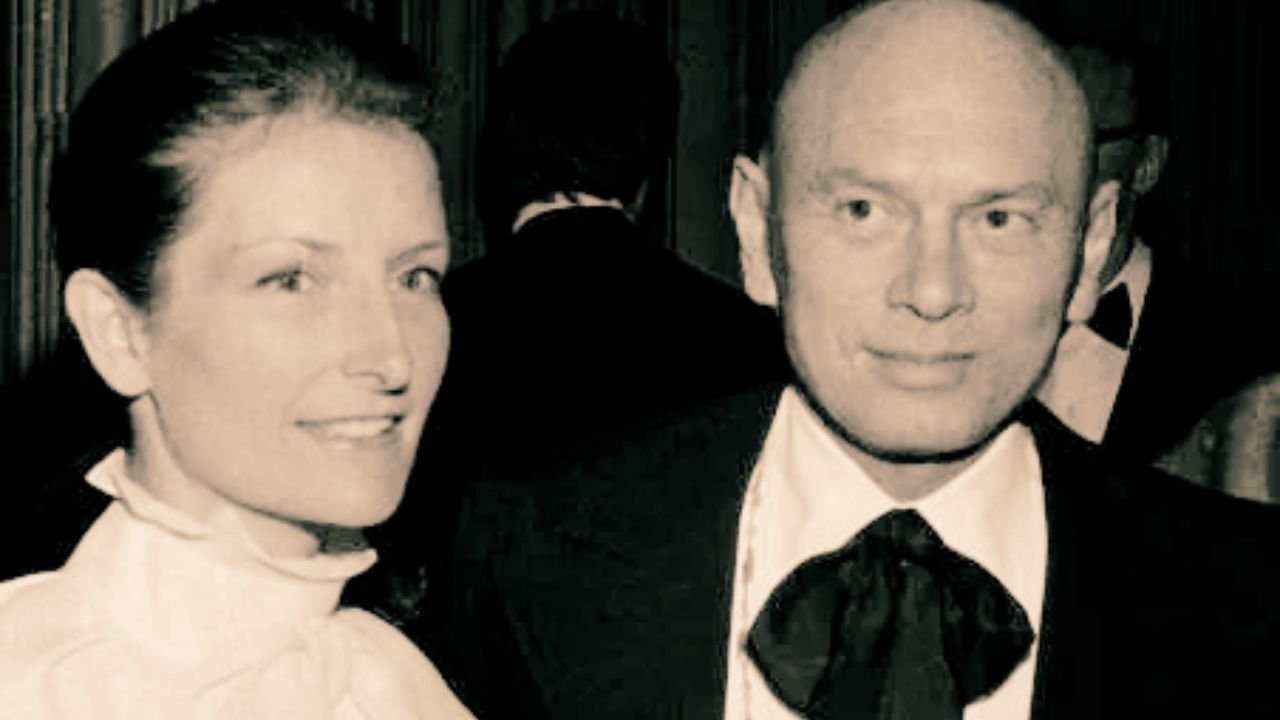
Yul Brynner is one of Hollywood’s most recognizable figures — the shaved head, the commanding presence, the Oscar-winning role in The King and I. But far less is written about the French socialite who became his third wife in 1971 and helped him build a family through adoption.
Her name appears in different forms depending on the source: Jacqueline De Croisset, Jacqueline Thion de la Chaume, or simply Jacqueline Thion. She was not a film star or a public figure in her own right. Yet her story connects two very different worlds — French aristocratic and literary circles, and the golden era of Hollywood.
This article covers what the historical record confirms about who she was, her family background, her marriages, and her life with Brynner.
The Woman Behind the Name — Jacqueline Thion de la Chaume
Her full name is reported in genealogy records as Jacqueline Simone Thion de la Chaume. She is also listed under the names Jacqueline Thion and Jacqueline De Croisset, the latter coming from her second marriage.
She was born into a prominent French family. Genealogy profiles on Geni list her parents as Robert Thion de la Chaume and Marie Le Blan. Beyond that, her early upbringing is not well documented in publicly available sources.
Her birth year is inconsistent across records. One narrative profile gives 1932 as her birth year, while Geni lists dates suggesting 1912. This discrepancy hasn’t been resolved by any authoritative public source, so it’s worth treating both figures with caution rather than picking one as definitive.
What sources do agree on is that she was a French socialite — someone embedded in high society by background and by marriage. Getty Images photo captions describe her as “socialite Jacqueline Thion de la Chaume, widow of Philippe de Croisset and ex-wife of actor Yul Brynner.” There is no record of a public professional career.
Her First Marriages and Life Before Brynner
According to genealogy records, Jacqueline was married three times in total. Her first marriage was to a man named Jacques Ouvrier. Details about this marriage are minimal in public records.
Her second marriage — and the one that gave her the name most people associate her with — was to Philippe Wiener de Croisset. Philippe was born in 1911 and was the son of Francis de Croisset, a well-known French playwright.
Philippe himself became a publishing executive, continuing the family’s involvement in French intellectual and cultural life. His death left Jacqueline a widow, which is how she is consistently described in contemporary accounts around the time of her marriage to Brynner.
A TIME magazine “Milestones” entry from October 1971 identifies her specifically as the “widow of French publishing executive Philippe de Croisset” at the time of the wedding. That brief description is one of the most direct contemporary references to her in mainstream media.
Her Place in the de Croisset and de Noailles Family Circle
Through her marriage to Philippe, Jacqueline became part of a notable French cultural network. Her father-in-law, Francis de Croisset, was a respected playwright and a figure in early 20th-century Parisian literary life.
But the family connection goes further. Francis de Croisset also served as stepfather to Marie-Laure de Noailles, one of the most influential art patrons in 20th-century France. She supported artists including Salvador Dalí, Man Ray, and Jean Cocteau, and her salons were central to the Parisian avant-garde scene.
This means Jacqueline — through her marriage to Philippe — moved in circles that were adjacent to some of the most significant artistic and aristocratic figures of modern French history. One source notes that she is referenced in the family tree of Marie-Laure de Noailles as a former sister-in-law who later became the third wife of Yul Brynner.
None of this suggests that Jacqueline herself was a figure in the art world. But it does provide a clear picture of the social world she came from — one rooted in French high society, literary tradition, and aristocratic family networks.
Marriage to Yul Brynner — Third Time for Both
Jacqueline married Yul Brynner on September 23, 1971, in Deauville, France. The TIME magazine entry from that year noted that it was the third marriage for both of them. Brynner was 51 at the time; Jacqueline was reported to be 38.
Brynner had previously been married to actress Virginia Gilmore (1944–1960), and then to Doris Kleiner (1960–1967). His fourth and final marriage, to Kathy Lee, came after his relationship with Jacqueline ended.
Their marriage lasted a decade, from 1971 to 1981. During that period, the couple was photographed together publicly, and Getty Images holds archive images of Brynner with Jacqueline and their family in California.
How the two met is not documented in any source currently available. Speculation about their courtship would go beyond what the record supports, so that part of the story simply remains private.
The Adoption of Mia and Melody Brynner
One of the most concrete parts of Jacqueline’s story is the family she and Brynner built together through adoption. During their marriage, the couple adopted two Vietnamese children.
- Mia Brynner, adopted in 1974
- Melody Brynner, adopted in 1975
MyHeritage records specifically describe Melody as “the adopted daughter of Yul Brynner and Jacqueline de Croisset.” Both daughters were adopted during the years surrounding the end of the Vietnam War, a period when international adoptions from Vietnam were relatively common among Western families.
Brynner already had biological children from his earlier marriages — son Rock Brynner and daughter Victoria. Mia and Melody added to that existing family. Beyond their names and approximate birth years, details about their later lives are not part of the public record.
The adoption of Mia and Melody is a meaningful part of Jacqueline’s story because it reflects an active choice to build a family — not just as a spouse, but as a parent. It’s also a detail that surfaces frequently in biographical summaries of Brynner, even when Jacqueline herself receives little more than a brief mention.
What the Record Says About Her Later Life?
After her marriage to Brynner ended in 1981, Jacqueline largely disappeared from public coverage. There is very little in mainstream media about her life after the divorce.
Brynner married for a fourth time, to Kathy Lee, and continued working in theater until his death in 1985. His final Broadway run of The King and I became one of the most celebrated theatrical farewells in American stage history.
One narrative profile states that Jacqueline de Croisset passed away in 2013. Geni’s listing for “Jacqueline Thion de la Chaume” also suggests dates of 1912–2013, though the birth year conflict noted earlier means that specific detail should be read carefully. What does appear consistent across sources is that she outlived Brynner by many years and lived a long life largely outside the public eye.
For readers interested in the broader celebrity world and the personal histories behind famous names, World Business Voice covers a range of profiles and cultural stories worth exploring.
Why So Little Is Known About Her?
It’s worth pausing to address something readers often notice: there is surprisingly little information about Jacqueline compared to the man she was married to for a decade.
The reasons are fairly straightforward. She was not an actress, a writer, a politician, or a public performer. She was a socialite — someone whose life existed within private social circles rather than in front of cameras or on public stages. That’s not unusual for people in her position, but it does mean the historical record is thin.
Most of what we know comes from three sources: genealogy platforms like Geni, WikiTree, and MyHeritage; brief references in biographical accounts of Yul Brynner; and photo archives where she appears alongside her famous husband. That’s a fairly narrow base of confirmed information, and this article sticks closely to it.
A Final Picture
Jacqueline De Croisset — born Jacqueline Simone Thion de la Chaume — was a French socialite who lived through some of the most culturally rich decades in 20th-century France. By family and marriage, she was connected to French literary and artistic circles. By her decade-long marriage to Yul Brynner, she became part of Hollywood’s story as well.
She is not remembered as a celebrity in her own right, and the public record offers only a partial picture of her life. But within that picture, a few things stand out clearly: a family background rooted in French high society, a place in an influential cultural network through her marriage to Philippe de Croisset, a ten-year marriage to one of cinema’s most distinctive stars, and the adoption of two daughters she and Brynner raised.
Also Read: